
Inherited Exile: Intergenerational Memory, Political Continuity, and Cuban American Identity
The execution of Ángel María Clausell García on April 29, 1959, at La Cabaña in Havana, Cuba, stands at the center of my family’s memory. He was my great-grandfather. Accused of a crime that was never meaningfully proven and denied due process, he was executed by firing squad by the revolutionary government. His death did not end with the moment of execution. It continued through the family he left behind, through the home that was taken, through the children who were forced to grow up too quickly, and through the stories that would later reach me as part of my own understanding of Cuba.
For my family, this history was never something distant. It was never confined to dates, archives, or political debates. It lived in the way my grandfather told the story, in the pauses between details, and in the phrase I heard often growing up: “We lost everything.” At first, I understood that phrase in a simple way. I thought of a house, a car, personal belongings, and the ordinary stability of family life. Over time, I came to understand that “everything” meant something much deeper. It meant the loss of dignity, security, childhood, country, and the right to live freely in the place one calls home. Cuba, for me, was therefore never introduced as an abstract subject. It was introduced as an inheritance. It was a place of beauty and loss, joy and rupture, memory and exile. My understanding of Cuba began not with a textbook, but with the story of a man whose name was carried forward because forgetting him would have meant allowing the violence done to him to become final.
A House Taken, A Childhood Interrupted
After my great-grandfather was killed, the government took away the family’s home, car, and means of stability. His wife was left with four young children and very little protection from the same political order that had already taken her husband. What had been a family life was suddenly broken apart by forces far larger than the household itself. Among those children was my grandfather, Juan José Clausell Alfaro. After his father’s execution, he was forced to leave school at the age of eleven in order to help his mother raise his siblings. That detail has always stayed with me. Eleven is an age that should still belong to childhood. It should belong to school, play, questions, and innocence. In his case, childhood was interrupted by history. The consequences of political repression were not theoretical. They entered his life directly and rearranged its entire course.
This is one of the reasons my family’s story has shaped me so deeply. The Cuban regime was never discussed in my family as a distant government with ideological flaws. It was understood as a system whose decisions reached into private lives and changed the fate of children. It took away not only property, but possibility. It did not only punish one man. It altered the future of an entire family. In that sense, my grandfather became one of the main carriers of this memory. Through him, the story did not remain frozen in 1959. It moved forward. It reached my mother. It reached me. It became part of how I learned to understand injustice, power, and the fragility of freedom.
Carrying Cuba Across Borders
On July 20, 1980, my grandfather left Cuba with his wife and two young daughters, including my mother, who was four years old at the time. In order to leave, he had to write a letter to the Cuban government stating that he opposed the regime because it had killed his father. That detail is important because it reveals that exile was not simply an act of departure. It was a statement of memory. My grandparents did not leave Cuba because the country had lost sentimental value. They left because the Cuba they loved had become a place where their family history could not be separated from fear, repression, and loss. Leaving was not an abandonment of Cuba. It was, in many ways, a refusal to surrender the truth of what had happened there.
Before arriving in the United States, my grandparents spent several months in Madrid, Spain. My grandfather sold cigars on Gran Vía. My grandmother cared for children. They were alone in a foreign country, with two daughters, depending on help from the Catholic Church while trying to find a way forward. That image has always felt meaningful to me – a family suspended between what had been lost and what had not yet been built. Eventually, they arrived at JFK Airport in New York City on November 25, 1980. From there, they went on to grow their family, work tirelessly, and build a stable and successful life in the United States, ultimately achieving the American Dream.
Their story faced hardships, but it is not only a story of pain. It is also a story of discipline, sacrifice, and reconstruction. My grandparents carried Cuba with them, but they did not allow loss to become the final chapter. They rebuilt. They worked. They created a future. In doing so, they taught me that exile is not only about what is taken away. It is also about what people manage to preserve.
The Stories That Raised Me
Growing up, I heard stories about Cuba often. My grandfather spoke about what the country had once been: beautiful, vibrant, joyful, and full of life. He also spoke about what had happened to it under the Castro regime: the fear, the imprisonments, the executions, the silencing, and the scarcity. These stories were not told to me as formal lessons, but they became lessons nonetheless. They taught me that memory can be a kind of map. It shows where a family has been, what it survived, and why certain convictions remain. Through my grandfather’s stories, I came to understand Cuba not only as the country of my ancestry, but as a place marked by unresolved grief and unfinished justice.
This is where my experience connects to broader ideas about memory and identity. Maurice Halbwachs argued that memory is shaped through social groups, especially through families and communities. Aleida Assmann’s work on cultural memory also helps explain how personal stories can become part of a larger framework of belonging and interpretation. In my family, memory was never only individual. It was shared, repeated, and preserved until it became part of how later generations understood themselves. Still, I do not see my views on Cuba as something I accepted without thought. As I grew older, I questioned, studied, and reflected more deeply. Rather than weakening the significance of what I had inherited, that process made it clearer. I came to understand that the stories I grew up with were not simply emotional accounts. They were rooted in lived experience. They carried historical weight.
Miami as an Archive of Exile
My upbringing in Miami also shaped the way I understood my family’s story. Miami was not simply the city where I grew up. It was a place where Cuban exile memory lived openly. It was present in conversations, family gatherings, restaurants, neighborhoods, and political discussions. The story of my family was specific, but it was not isolated. Many Cuban American families carried similar memories: homes left behind, relatives imprisoned, childhoods disrupted, and lives rebuilt from very little. In this way, Miami became a kind of living archive. It held the stories of those who had left Cuba but never stopped carrying it.
María Cristina García’s Havana USA speaks to this larger Cuban exile experience, particularly in South Florida. Cuban exile identity was not shaped only by immigration, but by political memory, loss, anti-Castro sentiment, and the expectation that Cuba’s story remained unfinished. This is important because it helps explain why exile identity can remain so strong across generations. It is not based only on nostalgia. It is based on the belief that memory still has something to say. At the same time, the Cuban American community is not politically uniform. Studies such as the FIU Cuba Poll, led by Guillermo J. Grenier, show both continuity and change across generations. Benjamin Bishin and Casey Klofstad have also written about the political incorporation of Cuban Americans and the ways political behavior has shifted over time. These changes matter. However, in families where direct memories of repression remain vivid, political continuity can still be deeply meaningful. In my case, that continuity has never felt like passive inheritance. It has felt like responsibility.
What I Inherited
As a second-generation Cuban American, I did not live through the events that shaped my family’s exile. I did not know Cuba before the revolution. I did not witness my great-grandfather’s execution, my grandfather’s interrupted childhood, or my grandparents’ first years of hardship in exile. Yet these memories have shaped me because they were passed down with clarity and purpose. I inherited more than a political opinion. I inherited a family history that taught me how power can wound, how freedom can be lost, and how memory can survive displacement. I inherited the understanding that a country can remain alive in a family even after that family has been forced to leave it.
This inheritance has also shaped how I understand my own freedom. The ability to write about this history, to study it, to speak openly, and to reflect critically is not something I take lightly. It is part of what my family was denied. That freedom gives memory a particular responsibility. To remember is not only to look backward. It is to carry forward what should not be erased.
The Country That Lives in Memory
Cuba’s history is often discussed through governments, revolutions, policies, and ideologies. Those frameworks matter, but they do not tell the whole story. Cuba’s history also lives in families. It lives in the stories of those who lost homes, relatives, childhoods, and futures. It lives in those who rebuilt their lives elsewhere while continuing to carry the country within them. My family’s history demonstrates how exile does not end with departure. It continues through memory, identity, and the way later generations come to understand themselves. The execution of Ángel María Clausell García did not remain in 1959. Its consequences moved through my grandfather’s life, through my mother’s migration, and through my own understanding of what Cuba means.
For me, Cuba is not only a place on a map. It is a country carried through stories. It is the beauty my grandfather remembered, the loss my family endured, and the hope that one day memory may no longer have to carry so much grief. My family lost a country, but they did not lose their memory. Because of that, I inherited more than the story of exile. I inherited the responsibility to remember.
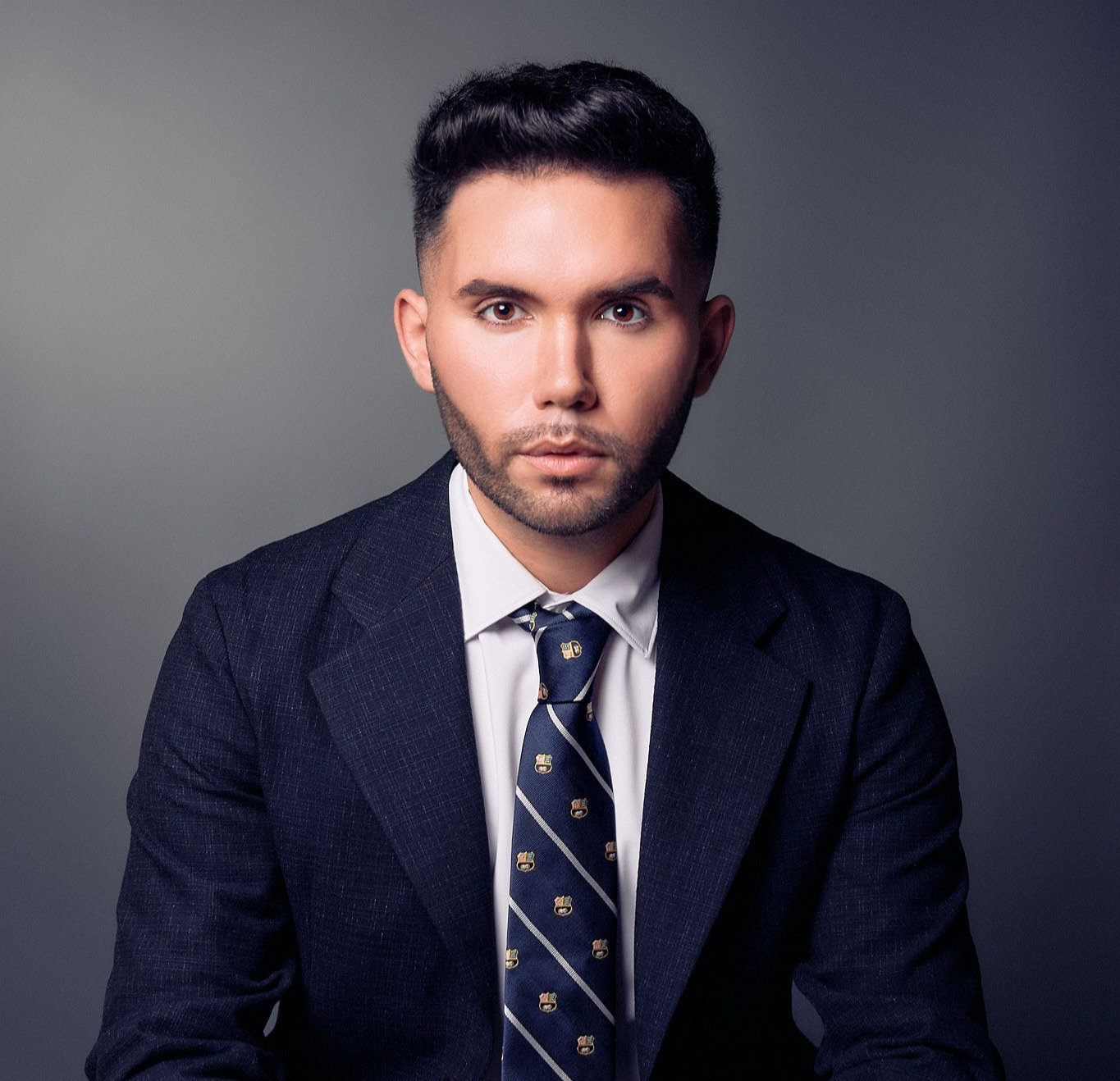
Alain Breton is a Cuban American graduate scholar and emerging professional whose academic and professional background reflects a strong foundation in political science, international affairs, strategic communication, and public-facing leadership. He holds a Bachelor of Arts in Political Science from Baruch College's Weissman School of Arts and Sciences NYC and is currently completing a Master of Arts in Political Science and Public Affairs, with a concentration in International Relations and Crisis Management, at Saint Louis University's Madrid Campus. He was awarded the Manresa Graduate Research Assistantship, recognizing his academic merit and research potential.
His experience spans finance, healthcare, luxury client relations, research, and nonprofit leadership, giving him a broad and adaptable professional perspective. Fluent in English and Spanish, Alain has developed a reputation for strong communication, analytical perspective, and the ability to engage effectively across diverse professional and cultural environments. His work is shaped by intellectual curiosity, refined judgment, and a commitment to producing thoughtful, well-researched, and impactful contributions across academic, professional, and public platforms.
The OCC publishes a wide range of opinions that are meant to help our readers think of International Relations. This publication reflects the views only of the author, and neither the OCC nor Saint Louis University can be held responsible for any use which may be made of the opinion of the author and/or the information contained therein.
To quote this article, please use the following reference:
Breton, Alain. “Inherited Exile: Intergenerational Memory, Political Continuity, and Cuban American Identity.” Observatory On Contemporary Crises, Observatory On Contemporary Crises, May 2026, www.crisesobservatory.org/post/inherited-exile-intergenerational-memory-political-continuity-and-cuban-american-identity.


Comments